
For hotel owners planning a refurbishment
FF&E Meaning in Hotels: What It Covers and How to Budget, Buy and Install It

Sviatoslav JerdetchiiCEO & Founder of Craftex. Updated , 6 min read
The short answer
FF&E means furniture, fixtures and equipment: the movable furniture, decorative fixtures and equipment that furnish a hotel, budgeted separately from the building work and from OS&E, the operating supplies.
- FF&E is beds, seating, case goods, lighting, artwork, curtains and in-room equipment.
- OS&E is linen, crockery, toiletries and small equipment: it wears out or is used up.
- Fixed fit-out, such as bathrooms, built-in joinery and services, sits in the building contract.
FF&E means furniture, fixtures and equipment. In a hotel it is the movable furniture, lighting, soft furnishings and equipment that make a building a place to stay. It is bought separately from the building work and from OS&E, the operating supplies.
This guide is for owners, asset managers and developers who are planning a refurbishment. It shows where FF&E starts and stops, how to budget it and who buys and installs it. Our hotel refurbishment and fit out team prices the works and the furniture on one programme. Holding a room count and dates? Get a free room-by-room cost plan.
FF&E meaning in a hotel
FF&E is everything a guest sees and touches that is not part of the building itself. The usual test is simple. An FF&E item has no permanent connection to the structure, so you could move it out without making good the walls.

In a hotel that means three groups of items.
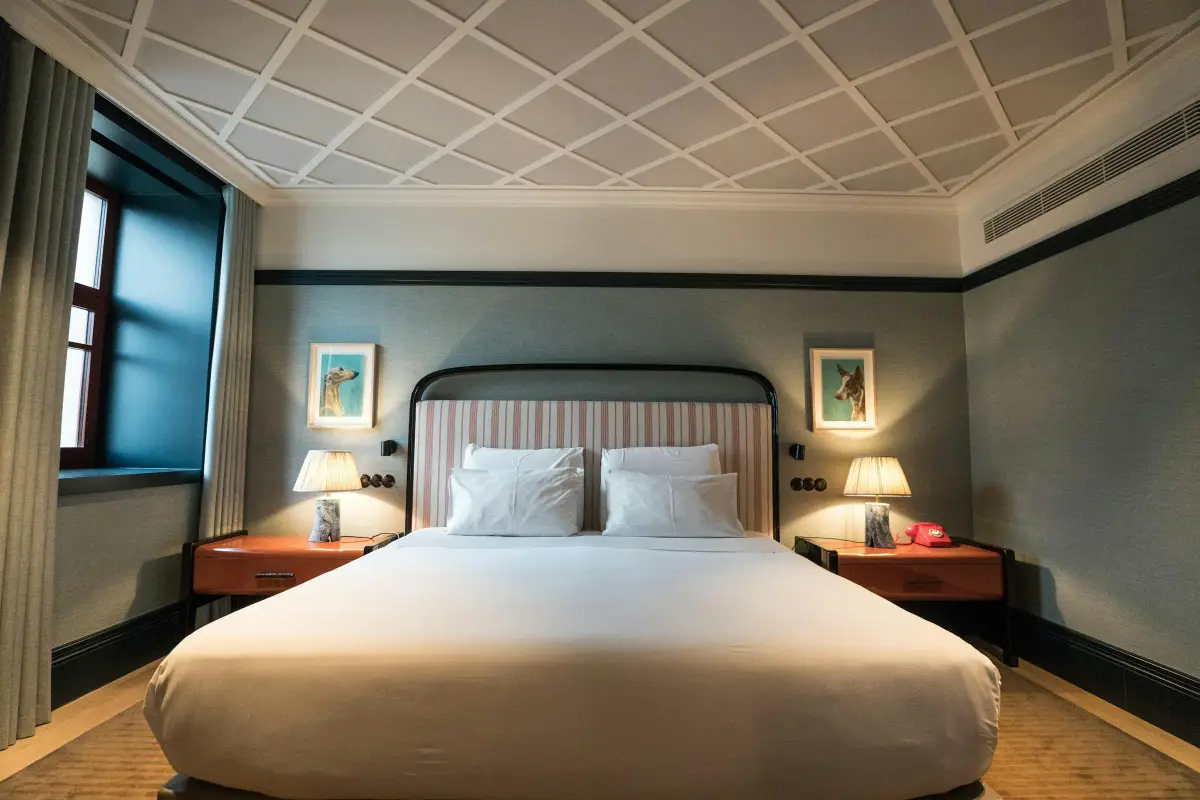
- Bedrooms and suites: beds, mattresses, headboards, bedside tables, wardrobes, desks, chairs, lamps, mirrors, artwork, curtains, rugs, TVs, safes and minibars.
- Public areas: reception furniture, lounge seating, bar stools, dining tables and chairs, planters, free-standing lighting and artwork.
- Back of house: kitchen equipment, laundry machines and staff-area furniture.
A hotel restaurant or bar adds its own list. Our guide to restaurant and bar fit-out covers it.
Fixed items, such as sanitaryware, built-in wardrobes and the fire alarm, belong to the building contract. They are not FF&E, even though a guest uses them every night.
FF&E vs OS&E vs fit-out
OS&E means operating supplies and equipment. These are the consumables and small items a hotel needs to open its doors and keep trading. They are used up, broken or replaced often. FF&E lasts for years and is replaced on a refurbishment cycle.
| Category | Hotel examples | Who usually buys | When it arrives |
|---|---|---|---|
| FF&E | Beds, seating, case goods, lamps, curtains, artwork, TVs, kitchen equipment | The owner, a procurement agent or the contractor | After decoration and flooring, before handover |
| OS&E | Linen, towels, crockery, glassware, cutlery, toiletries, housekeeping trolleys | The operator | In the last weeks before opening |
| Fixed fit-out | Bathrooms, built-in joinery, ceilings, flooring, wiring, plumbing, fire alarm | The contractor, in the building contract | Throughout the works |
The middle column matters most to the budget. Fixed fit-out is a construction cost. FF&E and OS&E are the owner's furnishing costs, and a lender or brand will often want them shown separately.
Our hotel refurbishment and fit out cost table covers the works only. It excludes FF&E, fees and VAT, so add them on top.
How to budget FF&E for a hotel refurbishment
Budget FF&E from a schedule, not from a rule of thumb. You will see per-room figures online. Most are US dollar figures for other markets, so we do not repeat them. A schedule priced from supplier quotes is a number you can defend. For the building cost beside it, see our guide to hotel refurbishment cost per room.

- Count the rooms by type: standard, superior, suite and accessible.
- List every item in one room of each type, with quantity, specification and finish.
- Multiply by the number of rooms of that type.
- Add the public areas and back of house, priced from the plans.
- Add delivery, installation, storage and VAT at 20%.
- Add a contingency for late changes, damage and re-orders.
Set the contingency in step 6 with care. Our guide on how much contingency a construction project needs explains how to set it. Keep the FF&E contingency apart from the building contingency, so one cannot quietly spend the other.
Price the sample room first. One finished bedroom tells you the real cost per room, and you can scale it. Our hotel refurbishment guide explains why a sample room comes before the main order.
FF&E procurement: who buys and who installs
Three routes are common. The right one depends on how much risk you want to carry.
- The owner buys direct. You or your designer order from suppliers and the contractor installs. You hold every delivery date, every storage problem and every damaged item.
- A procurement agent buys for you. A specialist sources, orders and tracks the items. You pay their fee, and you still coordinate the dates with the works.
- The contractor supplies and installs. One contract covers the works and the furniture. One party answers for dates, damage and snagging.
Whichever route you choose, four risks decide the outcome.
- Delivery dates. One late case good can hold a whole floor.
- Storage. A live hotel has few places to keep a floor's worth of wardrobes. Stored items get damaged and get in the way.
- Damage on delivery. Check it when the item arrives, not on handover day.
- Snagging. A faulty item needs a supplier and a fitter. Without one point of contact, the supplier blames the builder.
Sloane Place in Chelsea is a 27-key boutique hotel in a five-storey Victorian building. We took part in that refurbishment, which ran for 28 weeks. Its case study records joinery, M&E, finishes and FF&E coordinated through a single point of accountability.
Whichever route you choose, we coordinate FF&E delivery and installation inside the works programme.
Craftex has completed a range of both small and large-scale projects on our commercial property with exceptional precision and quality. Dmitriy consistently delivers courteous, prompt service and has shown great flexibility in accommodating last-minute changes to plans and timelines. I highly recommend Craftex for their professionalism and outstanding workmanship.
FF&E on the programme while the hotel trades
FF&E goes in last, but it is ordered first. Bespoke and imported items take the longest to arrive. Ask every supplier for a written, dated lead time, and put each date on the programme beside the works that must finish before it.
Order the furniture before the first floor is stripped. A bedroom is only finished when the bed, the lamps and the curtains are in.
A sensible sequence for each room runs like this.
- Finish the works, decoration and flooring, and clean.
- Deliver the FF&E to a protected space, not to the room.
- Install in a set order: case goods, bed, soft furnishings, lighting, artwork.
- Snag the room, then hand it to the operator for OS&E.
When the hotel stays open, deliver and install a floor at a time. Agree delivery hours, lift access and a separate route for deliveries with the operator. Closed rooms cost revenue, so a floor that is finished but waiting for furniture is the most expensive kind.
Fire, accessibility and tax checks for hotel FF&E
Fire
Under the Regulatory Reform (Fire Safety) Order 2005 the responsible person must keep a suitable and sufficient fire risk assessment. They must review it after a significant change to the premises, and a refurbishment is one.
Agree with whoever does the assessment which fire performance the upholstery, curtains and mattresses must meet. Ask suppliers for the test evidence before you order.
Accessibility
Approved Document M Volume 2 recommends at least one wheelchair-accessible bedroom for every 20 bedrooms, or part of 20, where Part M applies. A 27-bedroom hotel needs at least two.
These rooms need their own FF&E schedule. The guidance asks for an equivalent standard of amenity and an emergency assistance alarm that works from the bed and from the floor.
Tax
Many FF&E items can qualify as plant and machinery for capital allowances. HMRC's manual says to treat furniture, carpets and curtains, and items such as crockery and linen, like other plant. They must be durable and used in the trade.
Companies may use the Annual Investment Allowance, which gov.uk puts at £1 million, or other first-year allowances. Some fixed fit-out can qualify too, so the split in your tender list matters. Our guide to capital allowances explains the rules. Speak to your tax adviser.
Use this list before you place the first order. Send us the room count and get a free room-by-room cost plan. Already have a quote? Send it to us. We'll beat it. We take hotel works from £100,000.
- A written list of what is FF&E, OS&E and building contract, agreed before tender
- One schedule per room type, with quantity, specification and finish for every item
- Public areas and back of house priced from the plans
- Delivery, installation, storage and VAT at 20% added, plus a separate FF&E contingency
- A sample room signed off before the main order
- A written, dated lead time from every supplier, on the programme
- Fire test evidence for upholstery, curtains and mattresses, agreed with the fire risk assessor
- A separate schedule for the wheelchair-accessible bedrooms
- One named party for delivery, damage and snagging
- Capital allowances raised with your tax adviser before purchase


