
For business owners, landlords and finance directors
Solar Panels for Business: Are They Worth It?

Sviatoslav JerdetchiiCEO & Founder of Craftex. Updated , 5 min read
The short answer
Solar panels are usually worth it for a business that uses most of its power in daylight, on a roof with years of life left. Payback depends on self-use, the roof and the grid connection more than on the panels.
- Power you use on site saves the full import price; exported power earns much less.
- Companies can claim a 50% first-year allowance on solar, or use the Annual Investment Allowance.
- In England, panels are left out of business rates until 1 April 2035.
- Check the roof and the grid connection before you compare panel prices.
Solar panels for business are usually worth it when two things are true. The building uses most of its power in daylight, and the roof has years of life left. Get those right and the panels pay for themselves. Get them wrong and even a cheap array costs money.
This guide is for owners, landlords and finance directors deciding whether to go ahead. We design and install commercial solar panels with the roof and the electrics under one contract. So we see where the sums go right and where they go wrong. Want to know if your roof suits solar? Discuss your roof with us.
What drives payback on solar panels for a business
Payback is the installed cost divided by what the array saves each year. The saving depends far more on how you use the power than on the panels themselves.
Every kWh you use on site saves the full price you would have paid your supplier. Every kWh you export earns the Smart Export Guarantee rate, which each supplier sets and which is usually much lower. So a building busy in daylight pays back fastest.
The two guides differ mainly in the share of power they assume the site uses. Our commercial solar panel cost guide works the sum through for a 100 kWp array, with each figure's source.
Run your own sum on half-hourly meter data, not a yearly total. It shows the daytime load hour by hour. Leave out export income at first: if the array pays on self-use alone, export is a bonus.
Tax relief and capital allowances
Solar is plant for tax purposes, which can bring part of the cost forward. Solar panels are special rate expenditure under section 104A of the Capital Allowances Act 2001.
Three reliefs matter most:
- 50% first-year allowance. A company can claim it on special rate expenditure on new, unused plant, under section 45S.
- Annual Investment Allowance. Up to £1 million a year of plant and machinery, for companies, sole traders and most partnerships. You cannot claim both on the same cost.
- Business rates. In England, solar panels and their batteries are left out of rateable value for days before 1 April 2035, under SI 2022/405.
VAT on solar for business premises is charged at the standard rate. The zero rate covers homes and buildings used solely for charitable purposes. A VAT-registered business can normally recover it.
Check the roof before the panels
The roof is where most business solar projects go wrong. Solar Surveys looked at 575 UK commercial roofs between 2024 and 2026. About 35% needed remedial work or could not take panels, and about 5% could not take them at all.
Panels stay on a roof for decades. If the covering has a few years left, they will have to come off for the re-roof, and that cost wipes out years of savings.
A roof survey before design checks four things:
- The covering. Its condition and remaining life, and whether it should be renewed first.
- The structure. Whether purlins, frames and fixings can carry the extra load.
- Fragile areas. Rooflights and old fibre cement sheets that limit where panels and people can go.
- Fire and insurance. What your insurer requires; many refer to the RC62 code for PV on commercial roofs.
Our guide to single ply roofing covers which roof systems take panels best. Not sure about yours? Book a roof and solar survey.
Grid connection and the DNO
Any commercial array needs the network operator's say-so. Generation above 16 A per phase, about 3.68 kW, must meet Engineering Recommendation G99 and be approved by the local distribution network operator.
The answer can set your switch-on date. It may also say the local network needs work before a large array can export, or limit what you can send to the grid.
Apply early, with the array size, the site plan and the equipment details. A design that uses most of the power on site, or adds a battery, can ease the connection.
Export is paid under the Smart Export Guarantee for systems up to 5 MW. Ask suppliers for their rate in writing, as rates change.
Could not be HAPPIER with Sviat and the Craftex team, they certainly showed me that they’re the number one office design company in London that we’ve had the pleasure of working with. They gave us a unique design just like we wanted, and we loved the first initial draft of the concept. Also have to give them props for Construction, I gave them a tight timeline as we needed to move our team in ASAP, so they pulled double shifts and I didn’t see a drop in quality. Will be to talking to the team when we move up to our next bigger office. Highly recommended A+++
Buy, lease or PPA
There are three ways to pay for the panels, and each splits the saving differently.
| Route | Who owns the panels | You pay | You keep |
|---|---|---|---|
| Buy outright | You | The installed cost up front | The whole saving and the tax relief |
| Lease or finance | The funder, then you | Regular payments | The saving, less the payments |
| Power purchase agreement (PPA) | The provider | Only for the power, at an agreed rate | A smaller saving, no upfront cost |
Buying gives the best return when you have the cash and a long future in the building. A PPA suits a business that wants no capital outlay, but it ties the roof up for the length of the contract.
Tenants need the landlord's consent to alter the roof, and the lease should say what happens to the panels at the end. Landlords can also install panels and sell power to tenants, which can help a building's EPC rating.
Which buildings suit solar best
The best buildings combine a large, sound roof with a heavy daytime load.
- Factories and cold stores. Machines and refrigeration run all day, so nearly all the output is used on site.
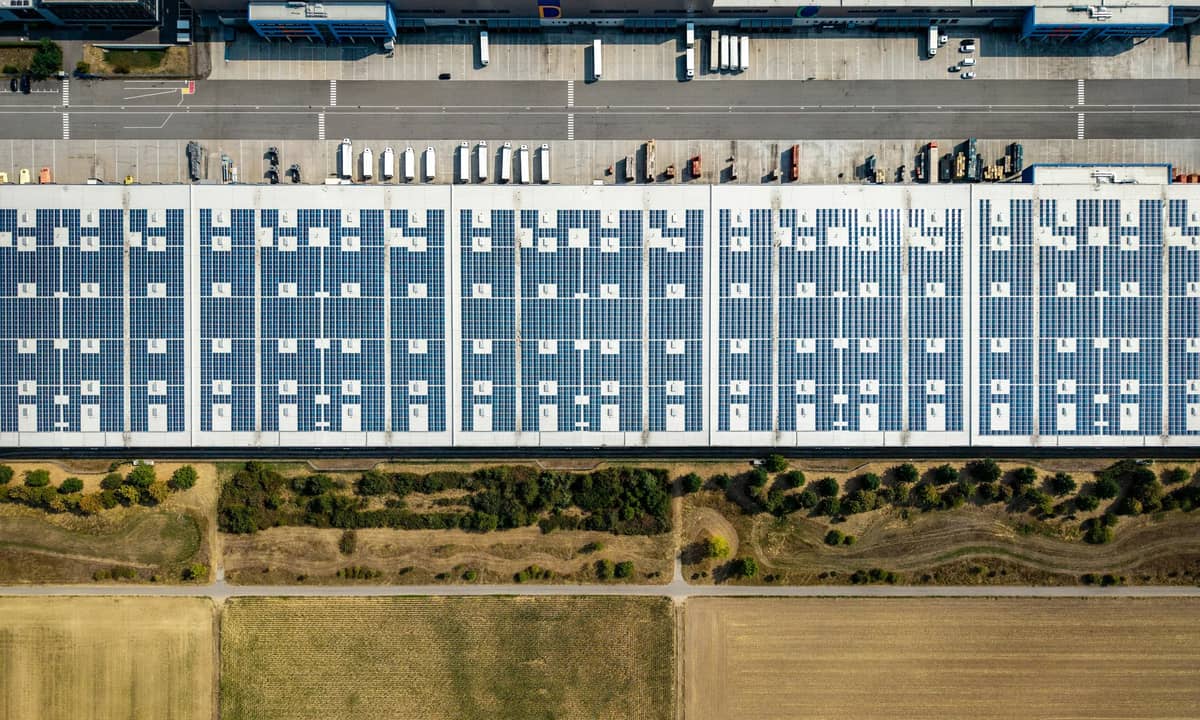
- Busy warehouses and distribution centres. Large roofs and daytime operations; check the roof first.
- Supermarkets and retail parks. Lighting and refrigeration through long opening hours, seven days a week.
- Offices. High weekday use, but a small roof for the load; the array is a saving, not an income.
- Car parks. Where the roof is small, a solar carport over the parking adds capacity.
Rooftop solar on non-domestic buildings is usually permitted development in England, with limits on height and roof edges. Our guide to solar panel planning permission covers the rules.
Before you decide on business solar
- Twelve months of half-hourly electricity data
- A roof survey: covering, structure, rooflights and fire
- Your insurer's conditions for PV on the roof
- An early application to the network operator
- Your accountant's view on capital allowances
- The lease, if you are a tenant or a landlord with tenants
- A clear choice between buying, leasing and a PPA


